Tuesday, May 5, 2020

Do you know your Vix Basics?

     Hello fellow members of the Facebook group Option Traders.  As one of the moderators of this group I am starting a series of blog posts aimed at providing a window into the world of theVix as well as into the world of moderating Facebook financial groups. We are a diverse group of to be sure and I fear the posts that are most memorable tend to be those that are removed for one violation or another. What you may not know is that the moderators and admins have our own chat where we discuss the markets and this group. Interacting with the people who I have met as a moderator here is one of the highlights of my trading day and when Jake, our defacto leader asked me to talk about the Vix for a moment here, I was happy to oblige.
     So I was thinking in preparation for writing something; what is the minimum a retail trader needs to know about the Vix? What is the shortest amount of blog posting I can do that will get across to a rookie trader the essence of the Vix and how this fits together with trading? I suppose the answer starts with talking about where the Vix came from and what it is as well as where I came from and who I am very quickly. So here goes :).
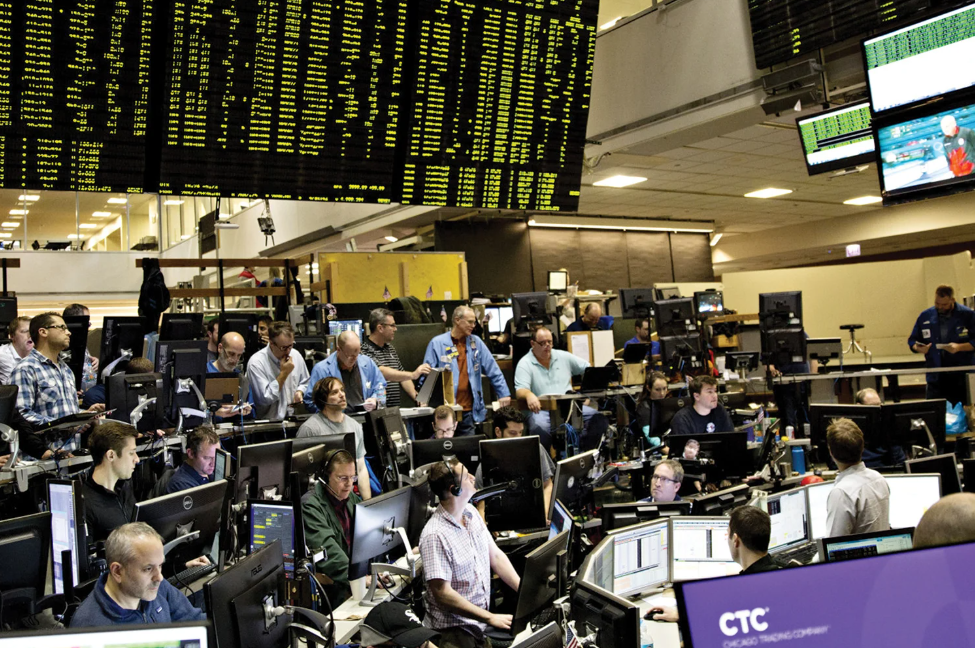
   The Vix appeared in the late 1990s and came out of the CBOE. The CBOE is a trading floor in Chicago, Illinois in the US. The trading floor was most active in the late 1980s and 1990s. Now it is closed due to the Covid thing but when it reopens around June 1st? it will be opening as it closed a month ago with the Vix pit and the SPX pit being the main products.  I was a trader at the CBOE from 1994-2003. Back then it had around 50 different "pits" or spots where people stood and used the open outcry system to trade stock and index options. There were around 50 small pits with somewhere between 3 and 20 stocks in each pit and each pit trading options on these products with different expiries. There were also some index pits, the biggest of which was the OEX pit with the SPX pit a close second and the NDX pit really not distinguishable in size from normal equity pits. All those pits are gone now from the CBOE and it is now a big empty area with the Vix and SPX trading areas at one end. 
   Back then in the late 1990s we became aware of the Vix as a number. It was like an indicator. As time went by however, futures on the Vix were created. The published number with the name Vix associated with it is based on a formula which samples a strip of option prices in the SPX. The SPX is an index of top US publicly traded companies. As option trades we have a way of comparing option prices of one stock to another. We talk about vol... So we may say that stock a has a vol of 55 average and stock b has a vol of 70 average.  Indices also have a vol number which is usually way lower than an individual stock. This sort of makes sense because the movement of several stocks together is going to be less than a single stock as several of the stocks will offset each other.
    Think of the Vix as the vol level of the SPX. It is actually more accurately the implied volatility of options on the Spx. The Vix is the price level of options in the Spx 30 days out in time. So if you were to pull up a screen with Spx options on it you would find that the level of prices on Spx options that expire around 30 days from now will correspond to the current price of the Vix.
   Why do you care? Well knowing the level of the Vix and following it day to day is going to give you useful information about the state of the financial markets. The Vix generally is higher when the markets are down and people are concerned and generally higher when markets are calm. This is why it is sometimes called the "fear gauge." A key takeaway is that the Vix is just a number that comes out of this formula. It is not shares of anything. There is no direct way to trade it. As previously stated there are Vix futures. These trade freely and although relate to the Vix, they do so in a complicated way. We use the Vix term structure to describe what is going on with them at any one point in time.
Vix futures however can be complex to trade and thus trading the Vix should occupy a separate space from considering the Vix and an indicator and a way to help you profit when trading equities (stocks) or options on stocks. For the purpose of this series we are going to stick to the Vix as an indicator and to ways we can use it to enhance our trading of other products.
   So there you go. That is a start.. More to come....... 
In the meantime please check me out on Youtube and sub to my channel to support me: https://www.youtube.com/user/Dewdrop142

Monday, May 4, 2020

Is trading part time better?

I work full time. I have a wife, two kids, and a mortgage. I have enjoyed investing and trading for many years (decades now that I think about it!), but have always needed to find a way to do it part time. Today, I explore some of the advantages to trading part time vs. full time.
  1. Free time. This is a “gimme”. Assuming trader A and trader B both make $50k a year trading and trader A can do it in 40 hours a week and trader B can do it in 5, I would much rather be trader B. This would allow for more free time to pursue other interests – read (or write) a book, go for a run, donate time to charity, or finally catch up on that Netflix (ticker: NFLX) series you keep hearing about.
  2. Planning. I cannot watch the markets all day. That means I need to set up my trades ahead of time and execute them in small windows of time when the market is open. The benefit is that I can really think through the trades before I put them on, considering what can go wrong, and making sure my sizing is appropriate.
  3. Discipline. A lot of traders suffer from “overtrading”. Staring at the screen, watching candles grow (or shrink) can lead traders to put on trades trying to catch small movements or “scalping” the market. While some are successful at this approach, many more are not. I don’t chase trades, I don’t try to scalp, I don’t see a short term loss and panic and put on more trades to get ‘even’. I Can’t do these things, since I simply don’t have the time.
  4. Defined risk. Traders that can watch the markets continuously have a bit more flexibility in the positions they put on as they can more easily adjust positions or more quickly take off losers. As I don’t have this flexibility, almost all of my trades have defined risk going in. That way, even if I can’t get to the markets, I know exactly how much I can lose on any given trade. If I keep this small enough relative to the size of my account, I can never go bust.
So what is the disadvantage?
Covered a bit in #4, there are simply certain trade types that I can’t put on and others that are harder to capture all the profits, since I can’t be in front of the screens all day. I think the advantages outweigh the disadvantages though. Disagree? Am I missing others? Drop us a line via email, Facebook, or Twitter.
Option Salary provides educational content, mentoring, and trade ideas to its free and paid members. 

Friday, May 1, 2020

Elon Meme


So the S.E.C. won't let be me or let me be me so let me see, they try to shut me down on the NYSE, but it'd feel so empty without me. 


Elon said Tesla stock price is too high. Do you agree? Leave comments below

Wednesday, April 29, 2020

WTF Chart of the Day:TSLA Afterhour

Click Photo to Enlarge


Tesla (TSLA), reported Q1 earnings after the bell today, surprisingly squeezing $16 million dollar profit. Beat the street estimates of -.36 a share by reporting 1.24 EPS with revenues of 5.9 Billion. The company has negative free cash flow of $895 million. Of course, like most companies, Tesla walked backed guidance for deliveries because of the COVID-19 Pandemic. Instead of maybe going up a few bucks, it went parabolic in the after hours session. Take a look for yourself at the 2 minute chart above. Elon Musk went on a profanity ridden tirade in the earnings call, slamming the shelter in place orders in the Bay Area.

Have a listen yourself here: Tesla Q1 Earnings Call


Disclosure: This is not intended to be investment advice. Entertainment purposes only, please do your own due diligence before investing. I have no position in the above stock.

Wednesday, April 1, 2020

Silver Futures Outlook


In regards to precious metals, I haven't traded them since last summer where I was too early on a trade so my caution is if trading options and buying calls/puts, please buy yourself enough time. I believe silver could retest the $13 level before heading higher. It was extremely oversold on the RSI, but the MACD cross was as clear as i'd like to see for continuing upward. I expect silver to consolidate around $13.00 and then continue upward over the next several months. I will be looking to buy calls on the SLV ETF when it is below 12.50.

Sunday, March 29, 2020

Crude Oil Outlook: Week of 3/30/2020


Although the demand for crude oil is down due to the COVID-19 pandemic, staying below $30 a barrel is temporary in my opinion. As you can see in the daily chart above, crude oil is extremely oversold according to RSI, along with an impending bullish MACD crossover. As I write this, crude is down 4.28%. Well it might take a while to regain highs of 2019 and even 2020, from a risk perspective,  going long here seems like the way to go. Also oil has been down due to Saudi cutting oils prices to take aim at Russia, they can reverse course at any moment which would likely send the price skyrocketing. Do your do diligence before investing.


Disclaimer: I am not a licensed finance professional. This blog is for educational purposes only and not to be construed as financial advice. Any trades you make are your own decision.


Until next time. Happy Trading.

UPDATE: I am long a short put spread 17 days out, sold a 14P, long a 14.5P for a credit of .11($110) less commission.

2nd UPDATE: closed out of the above put spread. Bought back the spread for .04 plus commission.